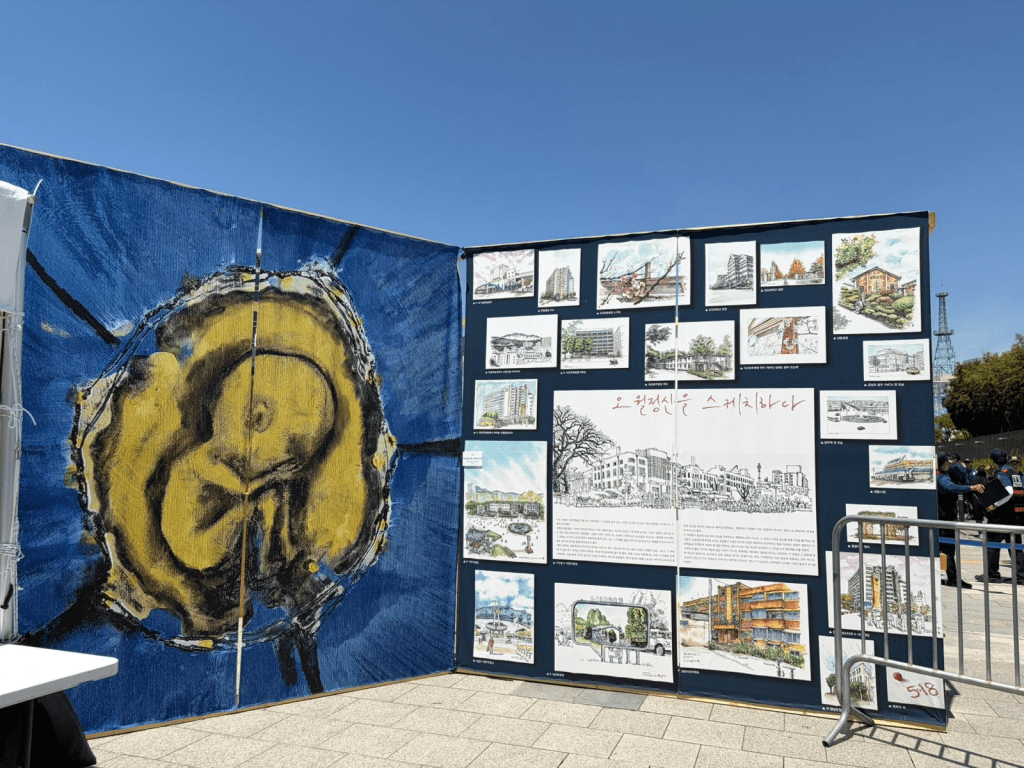
Living in Seoul, you learn quickly that this city does not pause. People move through subway stations with a kind of focused efficiency that I find both admirable and slightly disorienting. There is always somewhere to be, something to accomplish, a next step. When I took the KTX down to Gwangju to visit the May 18th Memorial — to learn something about the 1980 massacre, about citizens killed by their own military — and met the people, I came back to Seoul and watched the city keep moving. The same rhythms. The same pace. And I thought: how do these two things exist in the same country?
That is the question I want to sit with in this piece. Not why all of Korea remembers — because I am not sure that is true. But why do some people here refuse to stop fighting, long after the moment when most societies would have moved on? The comfort women who spent decades demanding an apology from Japan for wartime sexual slavery. The families of the 304 people who died in the Sewol ferry disaster of 2014, who are still — more than ten years later — in the streets, in courts, in public memory. The bereaved of the Itaewon crowd crush of 2022, 159 dead, are insisting that this was not an accident but a failure. And now, the families of the Jeju Air crash of December 2024 are asking the same questions again.
In many parts of the world, disasters like these are eventually absorbed into something like fate. Time passes. Grief becomes private. The city keeps moving. I know this pattern — it is familiar to me from my own context in Indonesia. So I find myself genuinely curious: what is it that makes some people, in some societies, refuse that absorption?
It is not all of Korea. It is specific people — bereaved families, survivors, certain activists — who decide that what happened to them was not fate, and that someone needs to say so.
First: the question of who is actually fighting
I want to be careful here, because the temptation is to make a sweeping claim about Korean society — and Seoul pushes back against that claim every day. Most people around me are not actively mourning Gwangju or Sewol. They are working, studying, building careers, and navigating a highly competitive social structure. The collective memory that gets written about internationally — Korea’s remarkable culture of accountability — is not evenly distributed. It lives in specific communities: the families directly affected, civil society organisations, progressive religious communities, investigative journalists, and certain academic and legal networks.
The political theorist Judith Butler writes about which deaths are made grievable — meaning, which losses are recognised publicly as losses that matter, that deserve mourning, that carry political weight. Her argument is that this recognition is never automatic; it is produced through effort, through organization, through insistence that a death was not inevitable. What I observe in Korea is that this effort is sustained by a relatively small but persistent number of people who have made it their life’s work to keep certain deaths grievable — to prevent them from becoming statistics that Seoul walks past.
What makes that persistence possible
This is where I become genuinely curious about causes, and where I find myself holding several possible explanations at once without being certain which is primary.
One is structural: South Korea’s democratic development since 1987 has built the infrastructure — independent courts, investigative media, civil society organisations, legal aid — that makes sustained accountability campaigns viable. Amartya Sen, writing about development as freedom, argues that what economic and political development actually expands is people’s capability to act meaningfully in the world. The Sewol families had lawyers. The comfort women had international human rights platforms. The Itaewon bereaved could file lawsuits and expect them to be heard. That is not sentiment; it is capability built over decades of democratic struggle.
Another is cultural, though I want to use that word carefully. The Korean concept of han — a kind of accumulated collective grief and longing that does not resolve cleanly — is sometimes invoked to explain this endurance. I find it partially convincing. There is something in how Koreans I have spoken to talk about historical suffering — Japanese colonisation, the Korean War, the division — that feels like a living wound rather than a settled past. But I am wary of making culture do too much explanatory work. Han does not organise a legal campaign. People do. Culture provides the emotional texture; organisation provides the mechanism.
Family is also significant in a way that feels distinct here. Korean family structure — shaped by Confucian ethics around kinship and obligation — treats the death of a family member as something that implicates the whole relational network, not just the individual closest to the loss. When Sewol’s parents stood in front of the National Assembly, they were not only grieving privately; they were acting out a social role that Korean culture recognises as legitimate and even obligatory. The bereaved family as a public actor, carries moral weight here in a way that may not translate directly elsewhere.
Religion, and why I find it the most complicated variable
South Korea is religiously unusual: roughly half the population identifies with no religion, while the other half is spread across Protestant Christianity, Buddhism, Catholicism, and new religious movements — making it one of the most plural societies in the world in this respect. I find this genuinely interesting when thinking about grief.
Religious frameworks often offer narratives that absorb trauma into cosmological meaning — suffering as divine will, acceptance as virtue, death as transition. In societies dominated by a single religious tradition, this can work against political contestation. You grieve, you accept, you move on. But in Korea, no single framework dominates public responses to disaster. The pluralism may paradoxically leave more space for secular political grief — the insistence that suffering was caused by human failures, not fate, and that those failures require human answers.
What I noticed in Gwangju is that the Catholic community there was not quietist — priests were in the streets in 1980. Korean progressive Christianity has historically aligned with democratisation rather than with state authority. So religion here is not a substitute for political struggle; it has sometimes been a participant in it.
Education and the habit of asking why
Perhaps the most durable thread is education — not as an abstract value, but as a specific historical fact. South Korea’s student movements were central to democratisation. The 1987 June Uprising that ended military rule was substantially organised by university students. Critical questioning of state authority, historical consciousness, the idea that citizens have the right to know what happened to them — these are not naturally occurring instincts. They were cultivated through decades of political struggle that embedded itself in how educated Koreans understand their power relationship.
Judith Herman, in her foundational work on trauma and recovery, argues that acknowledgement — the public naming of what happened — is not optional for healing; it is structurally necessary. South Korea has invested, unevenly but genuinely, in institutional acknowledgement: the 5.18 Memorial Foundation, Truth and Reconciliation Commissions, and state-funded trauma counselling for Sewol families. These exist because citizens demanded them. And they reflect a society that has decided, through hard political work, that well-being after collective disaster is a public matter, not something to be resolved quietly at home.
What I keep coming back to is that none of this was given. The culture of memory was built through struggle, through refusal, through the specific people who decided not to let go.
What I am still uncertain about
I want to be honest that I am writing this as someone who is new here — learning Korean society from the outside, from subway stations in Seoul and a visit to Gwangju and many conversations I am still processing. I do not have a clean answer to why some people keep fighting. What I have is a set of conditions that seem to make it possible: democratic infrastructure, a culture that gives bereaved families public moral standing, a religiously plural landscape that does not offer a single narrative of acceptance, and an education system that has trained generations to ask structural questions about power.
But conditions do not explain everything. Because across the world, societies have had all of these things and still let their disasters dissolve into silence. What the few who keep fighting seem to share — in Korea and everywhere else — is a refusal to accept that what happened was inevitable. That refusal is political. It is also, I think, deeply human. And sitting in Seoul, watching the city move, I find myself holding a kind of quiet respect for the people who carry it — the ones who stay when everyone else has gone back to moving forward.
Butler, J. (2004). Precarious Life: The Powers of Mourning and Violence. Verso.
Herman, J. (1992). Trauma and Recovery. Basic Books.
Olick, J. K. (2007). The Politics of Regret: On Collective Memory and Historical Responsibility. Routledge.
Sen, A. (1999). Development as Freedom. Oxford University Press.
Choi, C. (1995). “The Discourse of Decolonization and Popular Memory: South Korea.” Positions, 1(1), 77–102.
Deuchler, M. (1992). The Confucian Transformation of Korea. Harvard University Asia Center.
Kim, E. (2017). “The Sewol Ferry Disaster and the Politics of Accountability in South Korea.” Asian Politics & Policy, 9(4).
Korea General Social Survey. (2021). Religious Affiliation and Belief in South Korea. KSDC.


Leave a Reply